
Free Morse Code Generator & Alphabet Converter
Instantly convert text to Morse code and decode Morse code to text with live preview. Generate audio signals with pitch control, practice WPM speeds, and inspect the complete International Morse code alphabet chart. Perfect for ham radio operators, developers, emergency signals, and Morse code tattoos.
Popular use cases:
Translate Text to Morse Code Signals
Morse Synthesizer & Code Converter
Type plain English text to generate Morse signals, or paste dots and dashes to decode back into text instantly.
Load Preset Expressions:
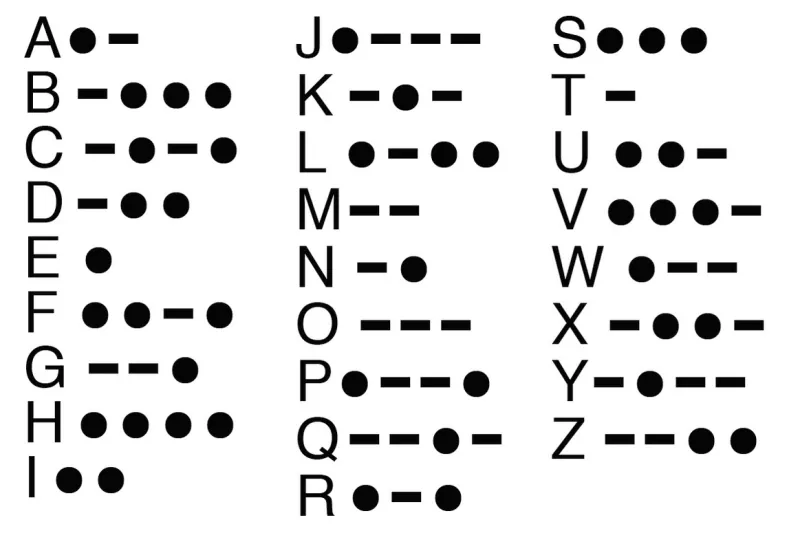
Complete International Morse Code Alphabet Chart
Click on any letter or number to listen to its audio frequency signal and copy its Morse code pattern.
Engineered for Precision & Total Privacy
Discover why radio operators, developers, and creators trust our client-side Web Audio synthesizer over generic tools.
Native Web Audio API
Synthesizes clean sine-wave audio tones locally without downloading external MP3 or WAV files.
WPM & Pitch Control
Fine-tune playback speeds from 10 to 35 WPM and adjust audio pitch frequencies between 400Hz and 900Hz.
100% Client-Side Privacy
All translations run strictly inside your browser. Zero server uploads, zero logs, zero telemetry.
Bidirectional Decoding
Seamlessly convert text into Morse code or paste raw dot-dash signals to decode back to plain text.
How the Morse Code Generator Works
Translate text, decode Morse code, and synthesize audio signals in three simple steps.
Enter Text or Morse Signals
Type plain text into the input field or paste existing Morse code dots and dashes directly into the code box.
Adjust Speed & Frequency
Use the WPM range slider to control signal speed and adjust the pitch frequency slider for comfortable listening.
Play Audio or Copy Signals
Click "Play Audio Tone" to broadcast the Web Audio signals live with flashing visual light, or copy code with 1-click.
Technical Specifications & Features Matrix
Compare audio synthesis parameters, timing standard formulas, and performance capabilities.
| Feature / Specification | Best Use Case | Audio / Output Spec | Privacy & Security | Performance Rating | Action |
|---|---|---|---|---|---|
| Web Audio API Synthesizer | Real-time Tone Playback & Ear Training | Sine Wave (400Hz - 900Hz) | 100% Local Hardware | Optimal (0ms Latency) | |
| Text to Morse Translator | Generating Morse Signals & Cipher Text | Standard Dot/Dash (`.` `-` `/`) | Zero Server Uploads | Instant Real-Time | |
| Reverse Morse Decoder | Decoding Dot-Dash Sequences to Text | Dictionary Array Parsing | Client-Side V8 Engine | Bidirectional Auto-Fix | |
| PARIS Timing Standard | WPM Speed Control & Rhythm Training | 10 WPM to 35 WPM Formula | Local Execution | ITU Standard Ratios | |
| Visual Strobe Beacon | Optical Light Signal Testing | Synchronized Flash Light | Zero Telemetry | Visual Light Strobe | |
| Alphabet Chart Library | Character Lookup & Single-Tone Testing | Full Alphanumeric + Symbols | Offline PWA Enabled | Complete Reference |
Comprehensive Guide to International Morse Code
Understanding timing ratios, audio tone synthesis, and emergency distress protocols.
1. What is International Morse Code?
Invented by Samuel Morse and Alfred Vail in the 1830s for electric telegraphy, Morse code encodes text characters as standardized sequences of short and long signals called dots (dit) and dashes (dah).
2. The PARIS Timing Standard Ratios
Morse code speed is measured in Words Per Minute (WPM) based on the standardized word "PARIS". The standard timing ratios are strictly maintained:
- Dot Duration: 1 basic time unit.
- Dash Duration: 3 time units.
- Intra-character Gap: 1 unit silence between dots/dashes in a letter.
- Letter Gap: 3 units silence between letters.
- Word Gap: 7 units silence between words.
3. Emergency Distress Signal: SOS Protocol
The universal distress signal SOS (··· −−− ···) was adopted at the International Radiotelegraphic Convention in 1906 because of its unmistakable continuous pattern. Contrary to popular belief, it does not stand for "Save Our Souls"—it was chosen solely for ease of transmission and instant recognition.
Everything you need to know about Morse Code translation
Clear answers on International Morse Code rules, Web Audio audio playback, WPM speed settings, reverse decoding, and visual strobes.
How does the online Morse Code Generator & Translator work?
Our tool translates plain text characters into International Morse Code dots (.) and dashes (-) in real time. It also features reverse decoding, allowing you to paste Morse signals to convert them back into plain English text.
How is Morse audio synthesized without external audio files?
We synthesize audio live inside your browser using the HTML5 Web Audio API. Pure sine-wave frequencies are generated dynamically by your device's audio hardware, eliminating external MP3/WAV file downloads.
What is the standard timing formula for Morse code speed (WPM)?
We implement the official International PARIS timing standard: 1 dot = 1 time unit, 1 dash = 3 units, intra-letter gap = 1 unit, letter gap = 3 units, and word gap = 7 units. Setting speed to 18 WPM calculates exact millisecond signal delays based on this formula.
Can I adjust the audio pitch frequency and speed WPM?
Yes! You can adjust signal playback speed from 10 to 35 WPM (Words Per Minute) and tune the audio pitch frequency between 400 Hz and 900 Hz using interactive range sliders.
Does this Morse code translator work offline?
Yes, 100%. Because all text translation, reverse decoding, and Web Audio API tone generation execute locally inside your web browser's JavaScript engine, the application operates completely offline without internet connectivity.
What is SOS in Morse Code?
SOS in Morse code is represented as three dots, three dashes, and three dots (··· −−− ···). It was established as the international distress signal at the 1906 Berlin Radiotelegraphic Convention due to its distinct, unmistakable rhythmic pattern.
Can I use this tool to design Morse code tattoos?
Yes! You can type custom names, inspirational quotes, or dates into the translator to output exact dot-dash sequences, perfect for tattoo typography, graphic design, and custom jewelry engravings.
How does reverse Morse code decoding work?
Simply type or paste raw Morse code signals into the code text area (using . for dots, - for dashes, and / for word spaces). Our algorithm instantly parses each signal group against the International Morse dictionary to render decoded text.
What symbols and punctuation marks are supported?
In addition to standard English letters (A-Z) and numbers (0-9), our generator supports full International punctuation including periods (.-.-.-), commas (--..--), question marks (..--..), apostrophes (.----.), exclamation marks (-.-.--), slash (-..-.), parentheses (-.--.-), ampersand (.-...), colon (---...), semicolon (-.-.-.), equals (-...-), plus (.-.-.), hyphen (-....-), underscore (..--.-), quotes (.-..-.), dollar sign (...-..-), and at symbol (.--.-.).
Is my text data stored or logged on your servers?
No. All processing is 100% client-side. Your input text, ciphers, or messages never leave your device and are never sent to remote cloud servers or databases.
What is the flashing signal beacon light?
The visual strobe beacon flashes in real-time synchronization with the audio beeps during playback. This allows users to visual-test light signals or practice visual optical Morse communication.
What is the difference between American Morse Code and International Morse Code?
American Morse Code (developed for wired telegraphy) used varying dot lengths and internal spaces for certain letters. International Morse Code (WRC-standardized) uses uniform 1-unit dots and 3-unit dashes, making it the global standard for radio telegraphy (CW) and modern emergency signaling.
How do ham radio operators use Morse code (CW)?
Amateur radio operators use Continuous Wave (CW) Morse code to communicate over long distances using low transmitter power. CW signals easily penetrate noise and interference where voice communications fail.
Is there any fee, daily limit, or registration required?
No. The Agenvix Morse Code Generator is 100% free with unlimited translations, no sign-ups, no paywalls, and zero watermarks.
Can I play audio tones for individual letters in the alphabet chart?
Yes! In the Interactive Alphabet Chart library, clicking on any letter (A-Z), number (0-9), or symbol card instantly triggers a synthesized audio preview of that specific character's Morse code signal.
How do I copy translated Morse code to my clipboard?
Click the 'Copy Code' button in the Morse Code editor box or the 'Copy Text' button to instantly copy the output string to your system clipboard with 1-click confirmation.
Explore Related Developer Utilities
Discover more free, zero-log web utilities engineered for speed and privacy.
QR Code Generator with Logo
Permanent static QR codes with custom logos, gradients, and lossless vector SVG export.
Icon Pack Generator
Generate favicon suites (16x16 up to 512x512) and HTML meta code from any image.
Base64 Encoder & Decoder
Convert text, strings, or images into Base64 Data URIs with zero server logging.
JSON Formatter & Validator
Prettify, format, repair syntax errors, and convert raw JSON data strings into trees.
SHA-256 Hash Generator
Generate cryptographic SHA-256, SHA-512, and HMAC checksums using Web Crypto API.
Discord Time Converter
Convert timestamps into Discord dynamic markdown formats (<t:unix:R>).